
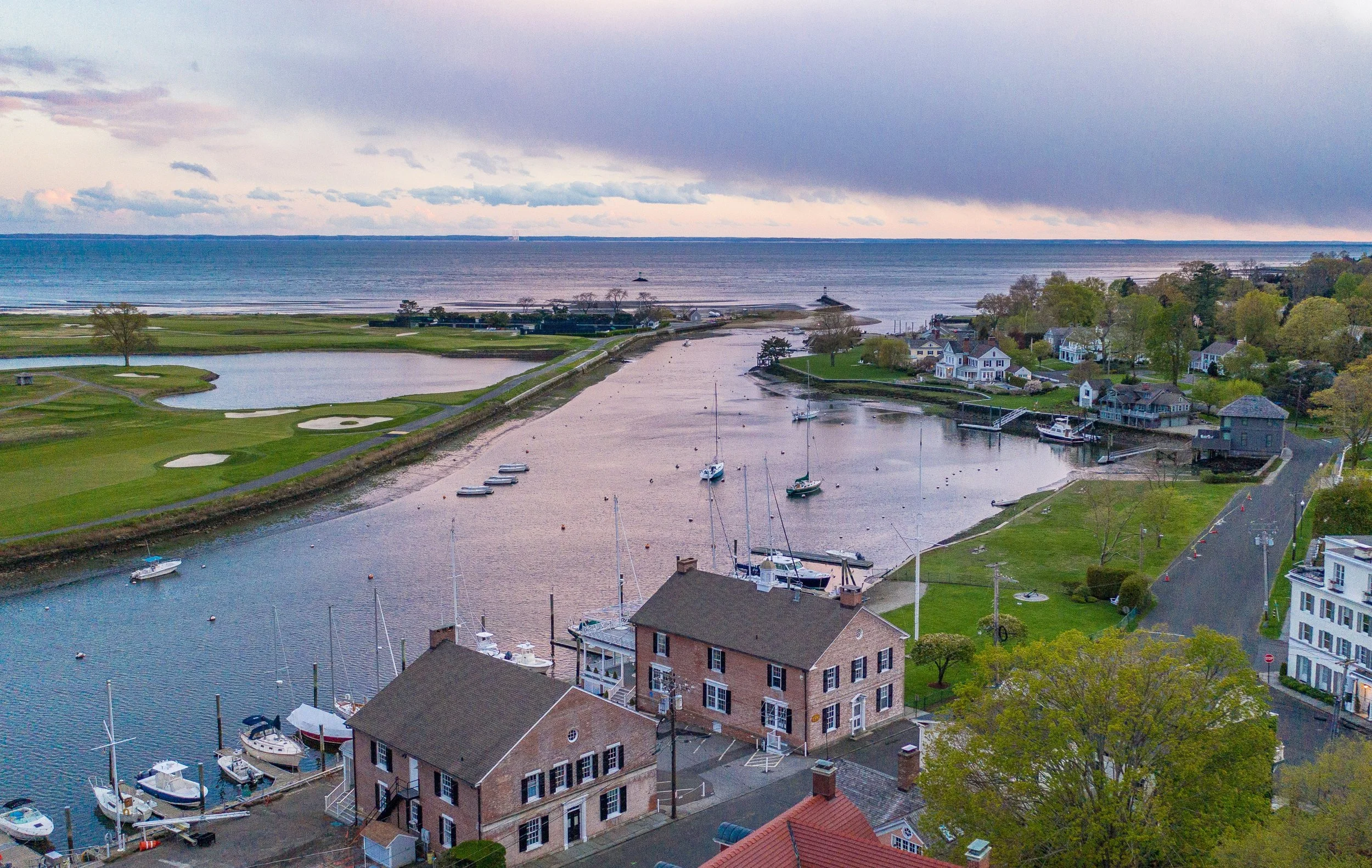
Southport is a coastal village that stretches about two miles inland from Long Island Sound, and part of the larger town of Fairfield, Connecticut. Walking the paved streets and pebbled lanes, one is immediately surrounded by the hamlet’s physical beauty and meticulous historic preservation, something so rarely found today in a pint-sized, urban environment.
In its first hundred years Fairfield was a farming community, and like much of 17th century Connecticut, the majority of town land was given over to communal farm lots and rolling pastures. But eventually, much of it was divided among several families (over 73,000 acres to approximately 50 families) many of whom still live and are part of the community fabric here.
The common lands along the shore were divided into small building lots for commerce and shipping. Original proprietors flourished in coastal trade of commodities such as flour, wheat, corn, pork and ultimately…onions. Southport became known as the Globe Onion Capitol of the country. Post Civil War, the sea routes between Boston, New York and Savannah were the pathways that enabled Southport farmers and merchants to reach diversified markets.
The most unexpected thing about Southport village is its understated formality that speaks to the pride and passion for preservation. Settlers fought long and hard to create this place, and residents, revering its past, want to keep it that way. Through the years, simple farm houses yielded to a more urban aesthetic that owners embraced after travelling to visit the best cities on the eastern seaboard. There is often a Southport flourish, architecturally— something to distinguish and elevate the front facade. Sea captains and merchants of industry all tried to outdo one another based on their respective fortunes. Just take a walk or quick run and count the number of Doric, Ionic and Corinthian columns adorning front porches and entryways!
Homes were build with adherence to the norms of the day and are still outwardly visible today:
Federal Classicism 1790-1820
Early Greek Classicism 1820-1835
Late Greek Classicism 1835-1850
The Queen Anne Country House
Some of the most picturesque streets to wander are Pequot Avenue, Harbor Road, Westway Road, Willow Street, Old South Road, Center Street, Rose Hill and Chester Place. Every spring, The Pequot Library sponsors the Garden Stroll which allows patrons to go behind the picket fences and stone walls to see the private lawns, gardens and outbuildings of these well-kept, timeless places.
Any historic town’s legacy cannot be compromised - it must be sensitively sustained and quietly heralded, and that is the ongoing goal of The Sasquanaug Conservancy for Southport. New bluestone sidewalks, a tucked away dog park, a new flagpole or two, and understanding the importance of redesigning an intersection for greater pedestrian ease are just a few of the most recent initiatives that have come to fruition.
A walk through Southport, Connecticut is like a stroll on vacation in a place that feels more old-fashioned and less harried. The way the homes relate to the land, the neighbors and the water, highlight an earlier time period. The shops, a few time-tested restaurants like The Horseshoe Cafe, public parks and the harbor are inviting spaces to pause, catch up, and take it all in. This village really is New England at its finest, and truth be told, it is just as charming on a bicycle!
*A special thanks to authors Jan Gagliano and Ralph G. Schwarz, who published an invaluable and comprehensive history of this New England gem: Southport The Architectural Legacy of a Connecticut Village.